Here is my film review, in the format prepared for publication in Where Peter Is – an online Catholic publication.
Update 22 April 2025: I wrote this in March and Pope Francis died on 21 April, so a real conclave follows and my guess is that it will be every bit as fraught as the battle presented in the film. The review was held back for publication awaiting the announcement of the real life conclave in Rome. (Note: the draft here has been revised for publication in WPI since the death of Pope Francis.)
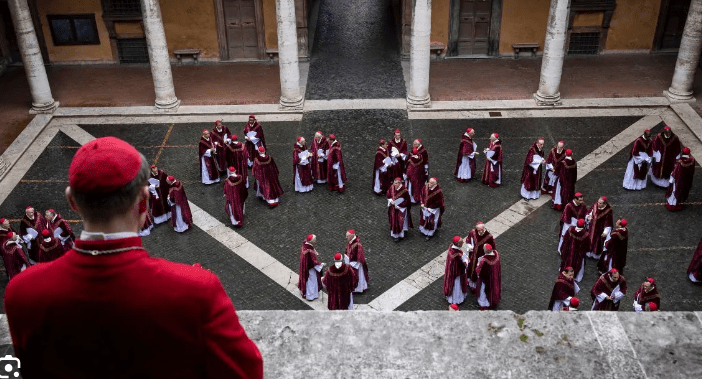
Conclave: a perfect film for an imperfect Church
By Gareth Thomas Weaver
Conclave is a multi award-winning 2024 film directed by Edward Berger and starring Ralph Fiennes as Cardinal Lawrence who is wracked by doubt but whose job it is to organise a conclave after the death of a pope whose reign has been progressive and whose legacy some cardinals wish to continue. They battle against reactionary conservative cardinals wanting to return to earlier certainties. Sounds familiar? It is indeed remarkably timely. The film explores ‘doubt’ as a major theme, but so you are left in no doubt at all, there are no plot spoilers in this review.
Many young Catholics will be unfamiliar with a conclave, having no memory of earlier ones, so the film is educational for the procedure alone. One cardinal has already given his seal of approval to the authenticity of the conclave in the film. [1] Early in the film, as Cardinal Lawrence is meticulously organising all the formalities, he says to the liberal Cardinal Bellini (Stanley Tucci), “This is a conclave, Aldo, it’s not a war…” But the angry animated answer comes straight back at him, “It is a war! And you have to commit to a side!” The battle for the future of the Church is on.
I consider Conclave as a ‘perfect’ film on its technical merits. Whether the story’s outcome can be described as perfect, however, will depend on the viewer’s theology and/or political stance. It is inevitable that Catholics in the pews will be divided as viewers, just as much as the cardinals in the film. Avoiding spoilers, I will simply say that Conclave’s final outcome is a surprise and genuine shock. Whatever one’s views within today’s imperfect Church, the ending will provoke lively discussion even within groups of like-minded faithful!
There are three ways in which I believe the film is technically perfect. The first is the story-telling, which can be broken down into three themes of opposites: doubt versus certainty; progressive reform versus hard conservatism; and male versus female. The film is honest enough not to resolve any of these opposites but we are drawn into the dynamic between them and the election outcome is credible. Doubt serving as a keystone of faith is a theme set out overtly in the conclave’s opening homily by Cardinal Lawrence: “If there was only certainty and no doubt, there would be no mystery, and therefore no need for faith.”
The arguments between progressives and conservatives are summarised with an economy that makes them clear enough to a non-Catholic audience, and the ‘thriller’ element – of course – is guessing which side’s machinations will prevail. In the theme of male versus female, the film presents powerful warring alpha males set against a domestic background of subservient passive female religious, working their chores in the cold marbled corridors of Casa Marta. We only hear one sister speak at any great length, the powerful but exquisitely understated superior, Sister Agnes played by Isabella Rosselini [2], who plays a key role in the plot and – just once – speaks passionately and out of turn. That key opposition of male and female is treated masterfully by director Peter Berger using the play of light and shadow for atmosphere and revelation, underscored in the very final shot of the film, with nuns coming out of Santa Marta into the cloister sunshine marking the end of the conclave.
This visual feast is the film’s second claim to technical perfection. Those familiar with Rome will know the long dark road tunnel which leads into Vatican City. (I know it well because I walked through it inch-by-inch on crutches when I was recuperating with a broken foot in the nearby convent of the Franciscan Friars of the Atonement, and it is a long tunnel!) The film’s opening shot shows us Cardinal Lawrence, striding hat-less through that tunnel, carrying a black briefcase, seen from a hand-held camera following behind him. It is a visual metaphor for the Catholic Church entering the tunnel of a conclave after the death of a pope. The days of enclosure in this tunnel will be stifling and intense, until white smoke finally emerges from the Sistine Chapel chimney (a vertical tunnel, to push the metaphor) and the windows can be thrown open to let in the sunlight once more. Conclave is visually stunning and for much of the two hours we must concentrate with our eyes, peering into these closed darkened halls. A Spanish woman in the row behind me in the cinema whispered loudly to her husband, “Está demasiado oscuro, no puedo ver lo que está pasando…” It’s too dark, I can’t see what’s happening. I smiled at the unintended irony.
Finally, for technical perfection, the actors all give authenticity to their roles in a spiritual battle of ideas, but the brilliance of the portrayal of Cardinal Lawrence by Ralph Fiennes must be singled out. This ‘doubting Thomas’ is a believable human being struggling with a doubt is so challenging that he had pleaded with the pope to be relieved of his duties and leave Rome to confront his doubt. Fiennes’ performance shows us a towering stalwart figure who simultaneously expresses the deepest human vulnerability. When he quotes the words of Jesus feeling forsaken on the cross, we are shown the doubting cardinal as a Christ-like figure, the true model for any man who would take on this mantle at the end of a conclave and lead the imperfect Church of our time. Such a one as Pope Francis, who spoke these words about doubt soon after his election:
“If one has the answers to all the questions, that is the proof that God is not with him. The great leaders of the people of God, like Moses, have always left room for doubt. You must leave room for the Lord, not for our certainties…” [3]
Notes:
[1] In a letter to Robert Harris, writer of the novel on which ‘Conclave’ is based, the Cardinal Archbishop of Westminster, Cormac Murphy-O’Connor praised its accuracy. Perhaps unsurprising because he acted as a consultant in the story’s research stage. (The screenplay adaptation is by Peter Straughan.)
[2] The actress is the daughter of Ingrid Bergman and the film director Roberto Rossellini.
[3] Interview given to Antonio Spadaro S.J. for America Magazine in 2013. https://www.americamagazine.org/faith/2013/09/30/big-heart-open-god-interview-pope-francis